Prebuilt Fence Panels
Prebuilt Wood Panels
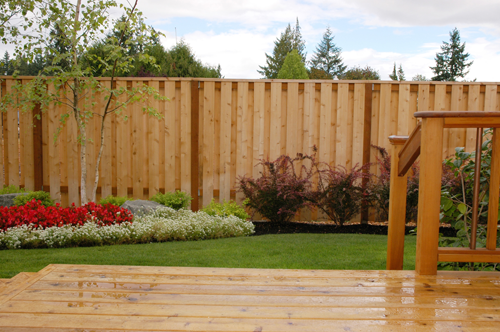 Cedar fences of many styles are available in pre-built wood panels from 3 ft to 6 ft high (0.9 m – 1.8 m). The panel boards may be plain, V-jointed tongue and groove, or channel patterns. Construction is usually 2″ x 4″ (51 mm x 102 mm) rails and 1″x 6″ (25 mm x 152 mm) boards. Cedar fence panel boards are usually butted tightly together but panels with spaced boards are also available. These time-saving cedar fence sections are sold by the panel.
You are advised to carefully examine wood fence panels to ensure that they are built from suitable quality cedar boards and are sturdily assembled with corrosion-resistant fasteners. When using pre-built fence panels it is important that you check the dimensions before installation. Good practice is to set posts and panels one at a time rather than pre-setting all posts.
Lattice Panels
Cedar lattice panels are an alternative or an addition to a solid cedar board fence. Rough or smooth-sawn lattice is available pre-built in a choice of square or diagonal patterns in modular sizes to match the most common prebuilt fence panels and post spacings. A lattice fence offers less wind resistance than a solid fence and allows sunlight into shady garden areas. The degree of privacy is governed by the obscurity ratio of the latticework. Clear cedar lattice is one popular option but lattice manufactured from cedar with sound tight knots is both economical and good quality. Lattice made from 1″x2″ (25 mm x 51 mm) cedar is more sturdy and lasts longer than panels made from lath.
When purchasing lattice, you should make sure that it is well-manufactured from good quality cedar of adequate thickness and that it has been correctly assembled. Heavier lattice panels are usually assembled with staples only and require no perimeter framing. Thinner lath lattice may be assembled with exterior-type glue and/or with staples. Lath lattice should be framed around its perimeter. The better quality lath lattice is stapled such that the crown of the staple is flush or counter-sunk in the wood and the points of the staple do not penetrate the face of the panel.
Available from our Premium Retailers